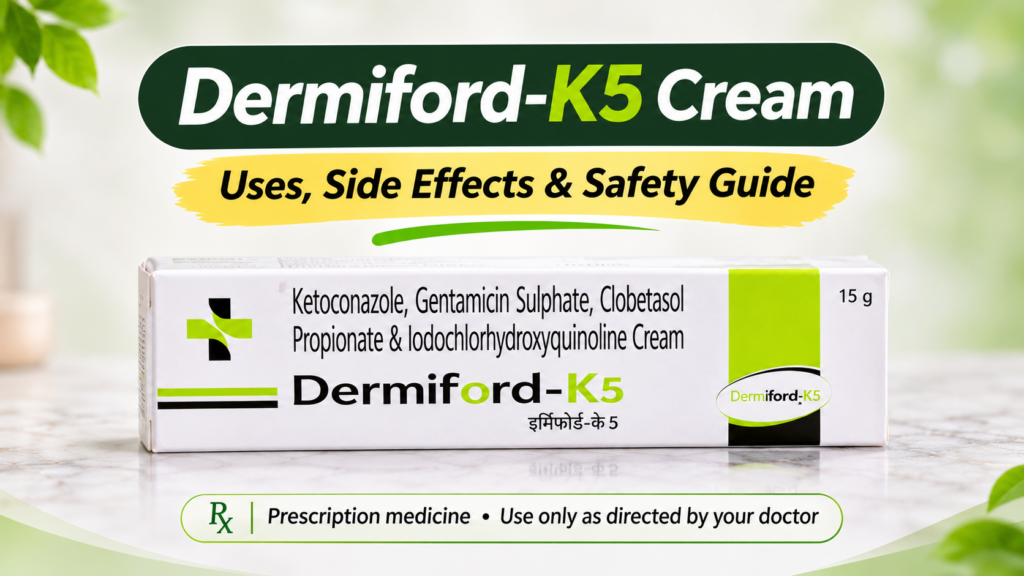
Dermiford K5 Cream is a prescription cream that combines a strong steroid with an antibiotic and two antifungal ingredients. It is meant for skin infections that are also red, swollen and itchy, and it should be used only as your doctor directs. It is not an everyday skin cream or a fairness cream.
Key Takeaways
- Dermiford K5 contains clobetasol (a very strong steroid), gentamicin (an antibiotic), ketoconazole (an antifungal) and clioquinol (an antimicrobial).
- The product listing says it needs a prescription and is for external use only.
- It is used for mixed bacterial and fungal skin infections with inflammation, such as infected eczema or dermatitis, ringworm, athlete’s foot and jock itch.
- Avoid the face, groin, armpits and under the breasts unless your doctor specifically advises it.
- Long or careless use of steroid creams can thin the skin, so stick to the course your doctor prescribed.
- Tell your doctor if the skin has not improved after about a week.
What Is in Dermiford K5 Cream?
The composition below is as shown on a major Indian pharmacy listing. Always check the tube or leaflet for the exact strength per gram.
| Ingredient | Amount listed | What it does |
|---|---|---|
| Clobetasol | 0.5 mg | Steroid that reduces redness, swelling and itching |
| Gentamicin | 1 mg | Antibiotic that stops bacteria from multiplying |
| Ketoconazole | 20 mg | Antifungal that damages the fungal cell membrane |
| Clioquinol | 10 mg | Antifungal and antibacterial agent |
The listing names Hinikam Drugs & Pharmaceuticals (Yamuna Nagar, Haryana) as the maker and marks it as a prescription medicine.
What Is Dermiford K5 Cream Used For?
It is used when a skin problem has both an infection and inflammation. The listing gives examples such as infected eczema, infected dermatitis, ringworm, athlete’s foot and jock itch. The steroid calms the redness and itch, while the other ingredients deal with the germs.
It is not suitable for every rash. Skin problems can look alike, and a steroid cream used on the wrong condition can hide or worsen an infection. That is why a doctor should first confirm what is causing the problem.
How to Use It
Follow your doctor’s instructions on how much to use and for how long. The general steps on the product listing are:
- Wash and dry the affected area.
- Apply a thin layer only to the affected skin.
- Wash your hands afterwards, unless your hands are the area being treated.
- Do not cover the area with an airtight bandage unless your doctor says so, because this increases how much steroid enters the body.
- Finish the full course even if the skin looks better, and use a moisturiser for dryness.
- If there is no improvement after about 1 week, go back to your doctor.
Possible Side Effects
The most common effects are local: burning, irritation, itching and redness where the cream is applied. Stop using it and get medical help if you notice swelling, a spreading rash or other signs of an allergic reaction.
With steroid creams, the main long-term concern is skin thinning. NHS-based guidance says this is rare with correct use, but the risk rises with strong steroids, long-term use, use on the face or skin folds, and use under bandages. Stretch marks and an acne-like rash on the face can also occur. Using large amounts for a long time can even affect the whole body.
Who Should Be Careful or Avoid It?
- Anyone allergic to any ingredient in the cream.
- Pregnant or breastfeeding women. Safety has not been established, so ask your doctor first.
- Children, who should only use it under a doctor’s guidance.
- People with broken, bleeding or ulcerated skin, unless a doctor directs otherwise.
- Anyone planning to use it near the eyes, nose or mouth. If it gets there, rinse with plenty of water.
Tell your doctor about any other creams or medicines you use. Clioquinol contains iodine, so mention it if you are due to have thyroid tests.
Why Self-Treatment With Steroid Creams Is Risky
Indian dermatologists have repeatedly warned about the misuse of topical steroids, including their sale and use without a proper diagnosis. A published review calls the problem serious and growing, with harmful local and whole-body effects when these creams are overused. Do not reuse an old tube for a new rash, share it with family members, or use it for dark spots or fairness.
Frequently Asked Questions
Can I use Dermiford K5 on my face?
Generally no. The listing advises avoiding the face, groin, armpits and under the breasts unless a doctor tells you otherwise, because the skin there absorbs steroids more easily.
Do I need a prescription?
Yes. The product listing marks it as prescription-only.
How long can I use it?
Only for as long as your doctor prescribes. Guidance on topical steroids notes that side effects become more likely after 1 to 2 months of continuous use, so repeated or open-ended use is not advised.
Is it safe in pregnancy?
Its safety in pregnancy and breastfeeding has not been established. Speak to your doctor before using it.
Can I stop as soon as the itching goes?
Your doctor will tell you when to stop. The listing advises completing the prescribed course, but you should also not extend it on your own.
Conclusion
Dermiford K5 Cream is a four-ingredient prescription cream for infected, inflamed skin. It can be effective when the diagnosis is right, but it contains a strong steroid and is not meant for casual or long-term use. Get the rash diagnosed, use the cream exactly as prescribed, and return to your doctor if it does not improve within a week.
References
- Dermiford K5 Cream product listing (1mg)
- Topical steroids (Guy’s and St Thomas’ NHS Foundation Trust)
- Topical corticosteroid misuse: the Indian scenario (PubMed)
This article is for general information only and is not medical advice. Do not start, stop or change any medicine without speaking to a qualified doctor or pharmacist.