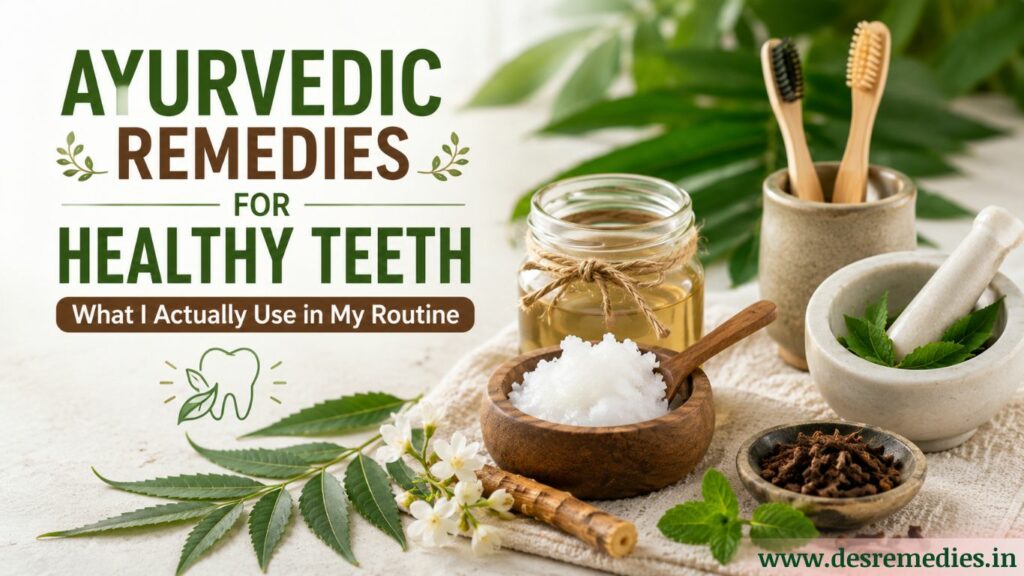
You may already brush your teeth twice a day and still wonder whether there is something more you can do for your oral health. I felt the same way when I started looking at Ayurvedic remedies for healthy teeth—but I didn’t want to add ten different remedies to my routine just because they were traditional. So I looked at what actually made sense, what I personally chose to keep, and where traditional oral care should stop and modern dental care should take over.
Key Takeaways
- Ayurvedic oral care includes practices such as oil pulling, tongue cleaning, and herbal oral-care traditions.
- Coconut oil is the oil I chose for my own oil-pulling routine because it is simple, accessible, and practical for me.
- Tongue cleaning is a simple Ayurvedic-inspired practice that may help reduce tongue coating and some measures of bad breath.
- Neem has been studied for plaque and gingival health, but the available evidence is not strong enough to treat neem as a replacement for standard dental care.
- Traditional remedies can complement oral hygiene, but they should not replace fluoride toothpaste, brushing, cleaning between teeth, or dental visits.
- The most useful Ayurvedic oral-care routine is a simple one that you can follow consistently without making unrealistic health claims.
- Personalization matters because the remedy you choose should fit your routine, comfort, and actual oral-health needs.
What Are Ayurvedic Remedies for Healthy Teeth?
Ayurvedic remedies for healthy teeth are traditional oral-care practices used in Ayurveda to support cleanliness and oral health. These practices include methods such as herbal chewing sticks, tongue cleaning, oil pulling, and herbal rinses.
First, Ayurveda has a long history of paying attention to oral hygiene rather than treating the mouth as something separate from general daily care. Traditional Ayurvedic texts describe practices including Dant Dhavani for cleaning the teeth, Jivha Lekhana for tongue scraping, and Gandusha or oil-based practices for oral care.
For example, neem has traditionally been used as a chewing stick, while tongue scraping has been used as part of morning oral hygiene.
At the same time, I don’t think every traditional practice needs to become part of a modern routine. A practice being traditional does not automatically mean that every health claim associated with it has been scientifically proven.
That is why I prefer a middle ground: keep the practices that are simple and sensible, look at the evidence where it exists, and continue the dental habits that have much stronger evidence behind them.
Why Are Ayurvedic Remedies for Healthy Teeth Worth Considering?
Ayurvedic oral-care practices can be worth considering as complementary habits when they are simple, safe, and used alongside evidence-based dental care.
First, what I like about many traditional practices is that they encourage daily attention to the mouth rather than waiting until something hurts.
For example, spending a minute cleaning your tongue each morning is a much smaller commitment than trying to overhaul your entire lifestyle.
Moreover, some Ayurvedic oral-care practices have actually been studied. A systematic review of neem mouthrinses identified three randomized controlled trials and found promising results for plaque and gingival inflammation, although the authors also noted that the evidence quality and study methods had important limitations.
Similarly, research on mechanical tongue cleaning has found potential benefits for reducing tongue coating and some measures of oral malodour when tongue cleaning is added to toothbrushing.
So for me, the point isn’t to choose Ayurveda versus dentistry.
It is about asking:
“Which traditional practices can I comfortably add without removing the things that are already known to protect my teeth?”
Also read: Bamboo Brush Benefits: Exploring the Eco-Friendly Way to Brush Your Teeth
Which Ayurvedic Remedies for Healthy Teeth Do I Actually Use?
The Ayurvedic-inspired practices I would keep in a simple daily routine are oil pulling and gentle tongue cleaning, while treating herbal remedies such as neem as optional rather than essential.
First, I don’t believe a healthy routine needs a long checklist.
For example, I would rather consistently brush, clean between my teeth, clean my tongue, and use coconut oil for oil pulling than attempt six different remedies for a week and then stop everything.
Here is how I think about the options:
| Practice | Why I consider it | My approach |
|---|---|---|
| Oil pulling | Traditional practice with some oral-health research | I use coconut oil |
| Tongue cleaning | Simple way to remove tongue coating | I keep it gentle |
| Neem | Traditional herbal oral-care ingredient with some research | Optional, not a daily essential |
| Clove | Traditionally associated with tooth discomfort | I would not use it to delay dental treatment |
| Herbal rinses | Used traditionally for oral hygiene | Consider only as an addition to regular care |
At the same time, I would not describe any of these as a cure for cavities, gum disease, or other dental conditions.
The goal is a practical oral-care routine, not a collection of remedies.
Is Oil Pulling One of the Best Ayurvedic Remedies for Healthy Teeth?
Oil pulling is one of the better-known Ayurvedic oral-care practices and is the remedy I chose to include in my own routine.
First, oil pulling involves gently swishing edible oil around the mouth and then spitting it out. Traditional Ayurvedic literature describes oil-based oral practices, although modern oil pulling has also become popular as a natural oral-care trend.
For me, coconut oil was the simplest choice because it is easy to find, familiar, and easy to include in a morning routine.
For example, I don’t need a special “oil pulling product” sitting in my bathroom. I can simply keep food-grade coconut oil available and use it as part of my routine.
Moreover, the research is interesting but not strong enough to justify the dramatic claims often made online. A 2022 meta-analysis included 9 randomized controlled trials and found a significant reduction in salivary bacterial colony counts, but it did not find significant differences in plaque or gingival-index scores.
That is why I see oil pulling as an additional practice, not the foundation of my oral hygiene.
Also read: Anushka Sharma practices this ancient Ayurvedic dental hygiene technique; know about it here
Why Did I Choose Coconut Oil?
I chose coconut oil for oil pulling because it is practical for my routine and has been studied in oral-health research.
First, convenience matters to me more than having a complicated wellness routine.
For example, coconut oil is easy to find and does not require me to order a specialized Ayurvedic product every time I run out.
Second, coconut oil has been investigated in randomized clinical trials. A systematic review identified four randomized controlled trials involving 182 participants, while also highlighting limitations such as small samples and short study periods.
So I am comfortable saying that coconut oil is my choice, but I would not turn that personal choice into a claim that it is the best oil for everyone.
That distinction is important.
Related read: Foods You Should Consume For Healthy & Germ-Free Teeth
Can Tongue Cleaning Help Keep Your Mouth Healthy?
Tongue cleaning can help remove tongue coating and may improve some measures of bad breath when used alongside regular toothbrushing.
First, tongue cleaning is one of the easiest Ayurvedic-inspired practices to add to a morning routine.
For example, after brushing or before breakfast, you can gently clean the surface of your tongue with a tongue scraper without pressing hard.
Moreover, research supports the basic idea that mechanical tongue cleaning can have an effect on oral malodour. A systematic review found positive effects from tongue brushing or scraping on several measures of breath odour and tongue coating, although evidence for chronic halitosis remained insufficient.
I like this practice because it doesn’t require adding another complicated ingredient to my routine.
Sometimes the simplest Ayurvedic remedy is simply better daily cleaning.
At the same time, tongue scraping should not become aggressive. If your tongue becomes sore, irritated, or starts bleeding, the pressure is too much.
Is Neem One of the Ayurvedic Remedies for Healthy Teeth Worth Trying?
Neem is a traditional Ayurvedic oral-care ingredient that has shown promising results in some studies, but the evidence is not strong enough to treat it as a replacement for standard dental care.
First, neem has a long history of use in Indian oral hygiene, particularly as a chewing stick. Ayurvedic literature describes neem among the plants traditionally used for cleaning the teeth.
For example, neem-based mouthrinses have been tested in clinical studies involving people with plaque-induced gingivitis.
Moreover, one randomized controlled trial involving 45 participants found that neem mouthrinse was associated with reductions in gingival, bleeding, and plaque indices over the study period.
However, a systematic review of neem mouthrinses reached a more cautious conclusion. It found promising results but noted heterogeneity between studies and limitations in evidence quality and reporting.
So I would place neem in the “interesting traditional option” category rather than the “must use every day” category.
Related read: Apple Cider Vinegar for Gum Infection: Natural Relief That Can Help
Can Clove Be Used as an Ayurvedic Remedy for Healthy Teeth?
Clove has a long traditional association with oral care, but using clove should not replace diagnosis or treatment for tooth pain.
First, this is one remedy where I would be particularly careful about online advice.
For example, someone with a painful tooth may find temporary comfort from a traditional remedy and then assume the underlying problem has been solved.
That can be risky because tooth pain can have different causes, including decay, infection, gum problems, or trauma.
Therefore, I would treat clove as a traditional comfort measure, not as a treatment for the cause of dental pain.
If tooth pain persists, becomes severe, or occurs with swelling or fever, professional dental evaluation is more important than continuing home remedies.
How Do I Fit Ayurvedic Remedies Into My Daily Oral-Care Routine?
I keep Ayurvedic oral care simple by using traditional practices as additions to, rather than replacements for, my regular dental routine.
First, my foundation is still ordinary dental hygiene.
The American Dental Association recommends brushing twice a day for two minutes with fluoride toothpaste and cleaning between the teeth daily.
For example, my routine can look something like this:
Morning
Morning is when I would keep the Ayurvedic-inspired part of the routine because it is easiest to remember.
First, I can start with gentle tongue cleaning.
Then, if I am doing oil pulling, I use the coconut oil I have chosen for my routine.
After that, I rinse and continue with normal toothbrushing.
Night
Night-time oral care stays focused on the basics because consistency matters more than adding multiple remedies.
First, I brush with fluoride toothpaste.
Then I clean between my teeth as part of my normal routine.
I don’t feel the need to add several herbal remedies simply because they are traditional.
A simple routine that I actually follow is more useful to me than a complicated routine that looks perfect on paper.
Can Ayurvedic Remedies Replace Fluoride Toothpaste?
Ayurvedic remedies should not replace fluoride toothpaste because traditional oral-care practices do not have the same evidence base for cavity prevention as fluoride toothpaste.
First, this is where I draw a clear line between traditional wellness and evidence-based dental care.
The American Dental Association recommends brushing twice daily for two minutes with fluoride toothpaste, and fluoride toothpaste has strong evidence for helping prevent tooth decay.
For example, an Ayurvedic mouth rinse may be something you choose to add to your routine, but it should not mean skipping your regular fluoride toothpaste.
Moreover, the ADA notes that toothpastes making cavity-protection claims with its Seal of Acceptance must contain fluoride.
That is why I don’t see this as Ayurveda versus modern dentistry.
I see the two as serving different purposes, with evidence-based dental care remaining the foundation.
What Ayurvedic Remedies Should You Be Careful With?
Ayurvedic oral remedies deserve caution when they involve concentrated ingredients, aggressive scraping, swallowing products, or delaying professional dental treatment.
First, natural ingredients are not automatically harmless simply because they come from plants.
For example, repeatedly rubbing strong substances directly onto teeth or gums can potentially irritate oral tissues.
Second, I would avoid aggressive tongue scraping.
A tongue scraper should remove surface coating, not scrape the tongue until it becomes sore.
Third, I would never use a home remedy as a reason to postpone dental treatment.
Persistent pain, swelling, bleeding, loose teeth, or a suspected cavity need proper dental evaluation.
What Does a Simple Ayurvedic Oral-Care Routine Look Like?
A simple Ayurvedic-inspired oral-care routine can include tongue cleaning and oil pulling while keeping brushing, fluoride toothpaste, and interdental cleaning as the foundation.
First, I would keep the routine small enough that it does not feel like another daily task.
For example:
- Clean the tongue gently.
- Use coconut oil for oil pulling if it suits you.
- Rinse and spit out the oil rather than swallowing it.
- Brush twice daily with fluoride toothpaste.
- Clean between your teeth daily.
- See a dentist when you have persistent symptoms or need professional care.
Moreover, I would not add neem, clove, or several herbal rinses simply to make the routine look more “Ayurvedic.”
The goal is not to use as many remedies as possible; the goal is to build a routine that is simple enough to follow.
What’s Next? How Can You Start Using Ayurvedic Remedies for Healthy Teeth?
The easiest way to start using Ayurvedic remedies for healthy teeth is to choose one simple practice, keep your regular dental routine intact, and see whether the addition works for you.
First, I would start with tongue cleaning because it requires almost no preparation.
Then, if you want to explore oil pulling, you can try the coconut oil approach that I chose for my own routine.
For example, you don’t need to buy several oils, herbal powders, mouthwashes, and supplements at the same time.
Instead, add one thing at a time.
Next, pay attention to how your mouth feels and whether the routine is comfortable enough to continue.
At the same time, remember that your personal experience can tell you whether a routine suits you, but it cannot prove that a remedy treats dental disease.
Best Oil for Oil Pulling: What I Chose for My Daily Routine
Conclusion: Which Ayurvedic Remedies for Healthy Teeth Would I Keep?
The Ayurvedic remedies for healthy teeth I find most practical are gentle tongue cleaning and oil pulling, with coconut oil being my personal oil choice.
First, I like these practices because they are simple enough to fit into an ordinary morning routine.
Second, I would keep neem and other herbal practices in the optional category because the evidence is promising in some areas but still limited.
Most importantly, I would not give up the basics.
Brushing twice a day with fluoride toothpaste and cleaning between your teeth remain the foundation of everyday oral care.
For me, that is the most sensible way to approach Ayurveda for oral health.
I don’t need to choose between traditional wisdom and modern dental care.
I can take the practices that make sense to me, use them thoughtfully, and still rely on proven dental care where it matters most.
A good oral-care routine doesn’t need to be complicated. It just needs to be one you can actually follow.